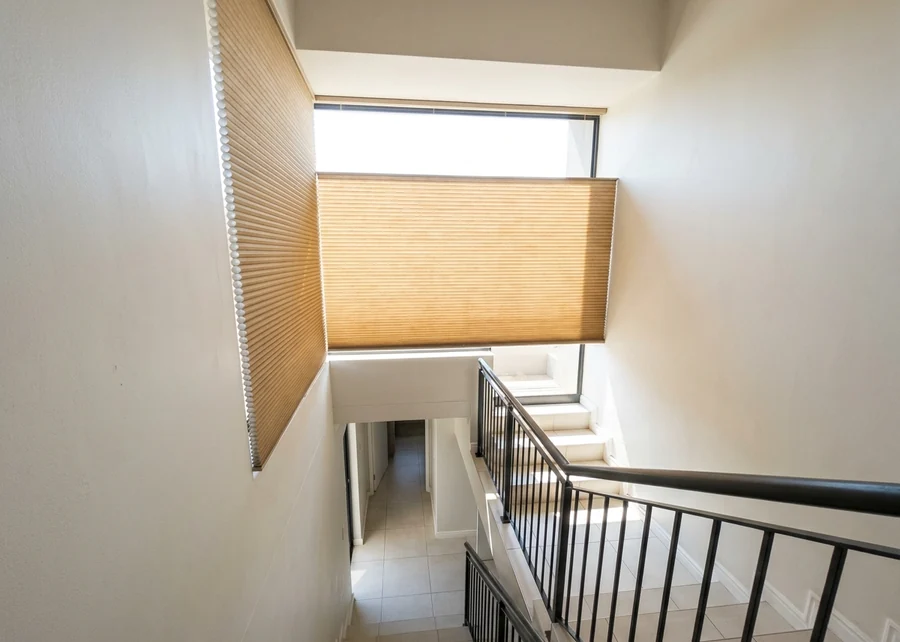
Cellular — or honeycomb — blinds fold pleated fabric into hexagonal cells in profile. Those trapped air pockets make this the best-insulating interior blind made: a soft thermal buffer sitting on the glass in both directions, useful on a Highveld property that swings from baking summer afternoons to properly cold winter nights.
The energy pitch, kept honest
Trapped air is insulation. Single-cell fabrics suit milder rooms; double cells do the more serious thermal work — a cooler room in summer, a warmer one in winter, and quieter too, since the cells absorb sound as well as heat. We keep the claims qualitative: real comfort and a lighter load on your heating and cooling, not invented percentages.
Light-filtering or blockout cells
Blockout cell fabrics give bedrooms genuine darkness with the thermal bonus built in — a strong combination for a Midstream main bedroom facing the morning sun.
Top-down / bottom-up
Privacy at the bottom, light and sky at the top. Excellent for street-facing rooms and any window overlooked from a neighbouring stand or upper storey.
Cordless and motorised operation are both available, and the cellular structure holds its shape well on skylights and shaped windows — useful in double-volume entrances and stairwells where a standard blind can't follow the angle.
Where cellular blinds earn their place
- Bedrooms and nurseries — dark, quiet and warm in one product.
- Rooms with real heating and cooling bills — home offices, media rooms, anywhere the aircon runs for hours.
- Skylights and angled glazing in double-volume spaces, where the cell structure holds shape better than a flat roller.
Fitted across the Midstream group
Cellular blinds do their best work on the Highveld's temperature swings, and we fit them right across the group — Irene, Southdowns Estate, Raslouw and Copperleaf Golf Estate included.
Common questions
Do cellular blinds actually make a noticeable difference to a room's temperature?+
Trapped air genuinely insulates — you'll feel it as a room that's less prone to sharp swings, especially with a double-cell blockout fabric. We keep this to honest, qualitative terms rather than quoting a percentage saving, because that depends on the whole room, not just the blind.
Can these go on a skylight or an angled window?+
Yes — the honeycomb structure holds its shape well on shaped and skylight openings, which is exactly where a standard flat roller struggles.
Are they hard to clean?+
A gentle vacuum brush attachment or a soft duster handles day-to-day dust well — we'll cover proper care for your specific fabric at the measure.