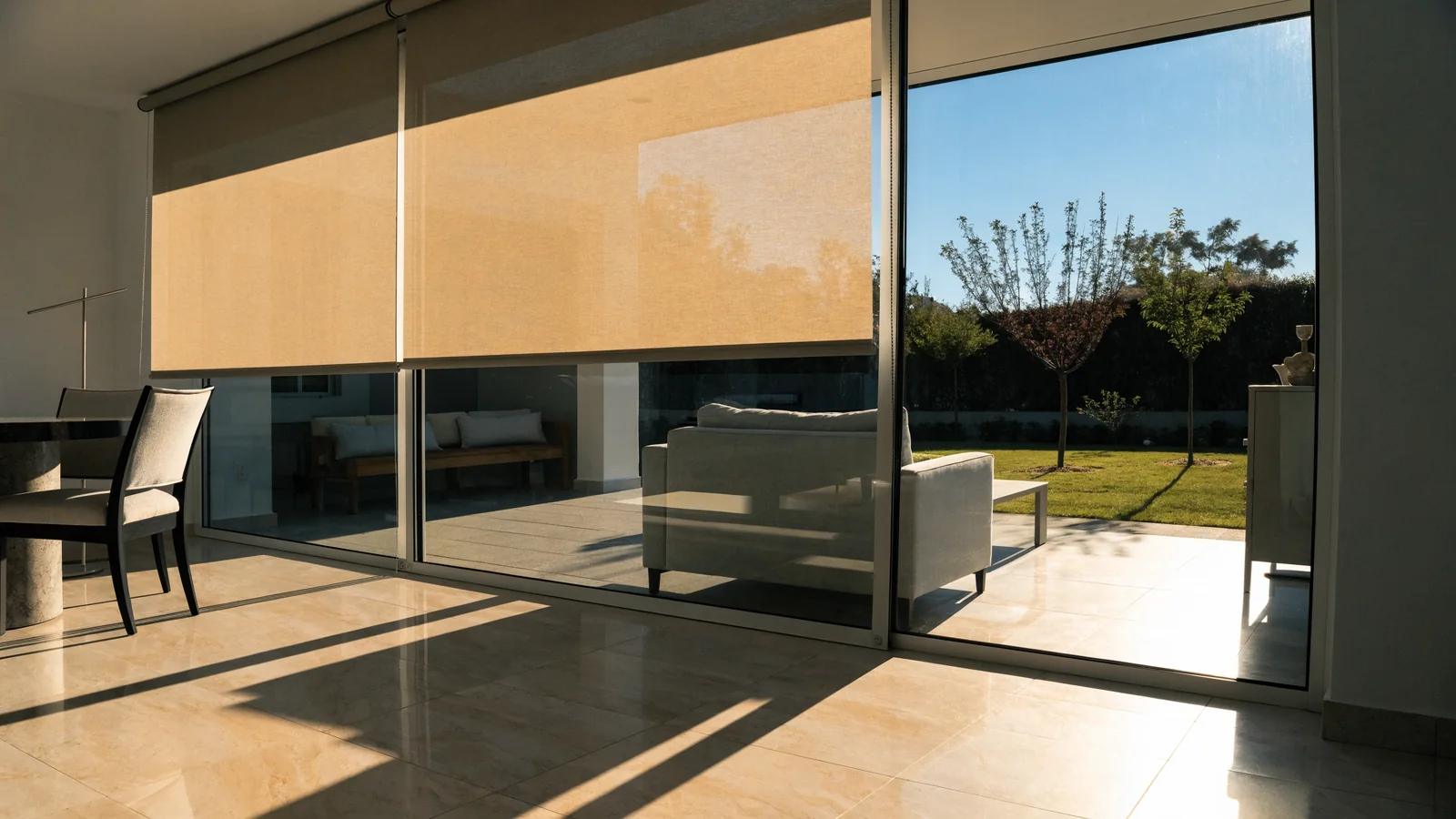
A single flat open-weave sunscreen roller blind, no folds, lowered halfway down a wall of floor-to-ceiling sliding glass in an open-plan Midstream Estate living room, with a covered patio, a manicured lawn and open Highveld sky beyond

Midstream Blinds / The Playbook

Free · un-gated · specific to this estate

The Midstream Light & Privacy PlaybookWhat the open Highveld sun does to a wall of estate glass through the year — elevation by elevation, and what we'd fit on each.

Midstream is wide, low and open, with young trees that haven't grown up to shade the glass yet — so what arrives at four o'clock arrives in full. Here is where the sun actually lands across the seasons, which rooms suffer, what we'd specify for each, and — honestly — what every one of those choices costs you in return.

About 8 minutes to read Written August 2026 No email needed to read it Sources at the foot

01 — The starting point

Why a Midstream home gets its own shading brief

Midstream isn't a street grid, it's a country in miniature: a group of joined residential precincts — Midstream, Midstream Heights, Midfield, Midlands, Midstream Ridge, Midstream Hill and Midstream Meadows, plus the Retire@Midstream village — spread wide and low under an open, uninterrupted Highveld sky south of Centurion.[1][2] The core estate alone runs to something like 1,400 stands, built out from around 2001 across freestanding houses, cluster homes, townhouses and apartments.[2] No two precincts look quite the same, but the floor plan underneath most of them is: a double-volume entrance, open-plan living opening straight onto a covered patio, and a wall of sliding glass facing the garden.

The glass is the whole point of the house — and almost nothing is shading it. In an older, leafy suburb half the sun problem is already solved by a neighbour's wall and a forty-year-old jacaranda four metres from the pane. Midstream is newer than its trees: the estate markets its "abundance of open green spaces and well-kept parks",[1] but the street trees are still young and the canopy hasn't filled in, so on most stands the afternoon sun reaches the living-room glass with nothing in the way.

The scale is the other half of it. Double-volume voids, three- and four-panel stacking doors and multi-blind living walls are the estate's default, which is exactly why so many Midstream jobs end up motorised — a run of glass that size was never going to work on a hand chain you can't reach. And because it is a managed estate, anything that reads on the outside of the house — an awning, an external screen, a roller shutter — is an aesthetics conversation as much as a measurement. We'll come back to that.

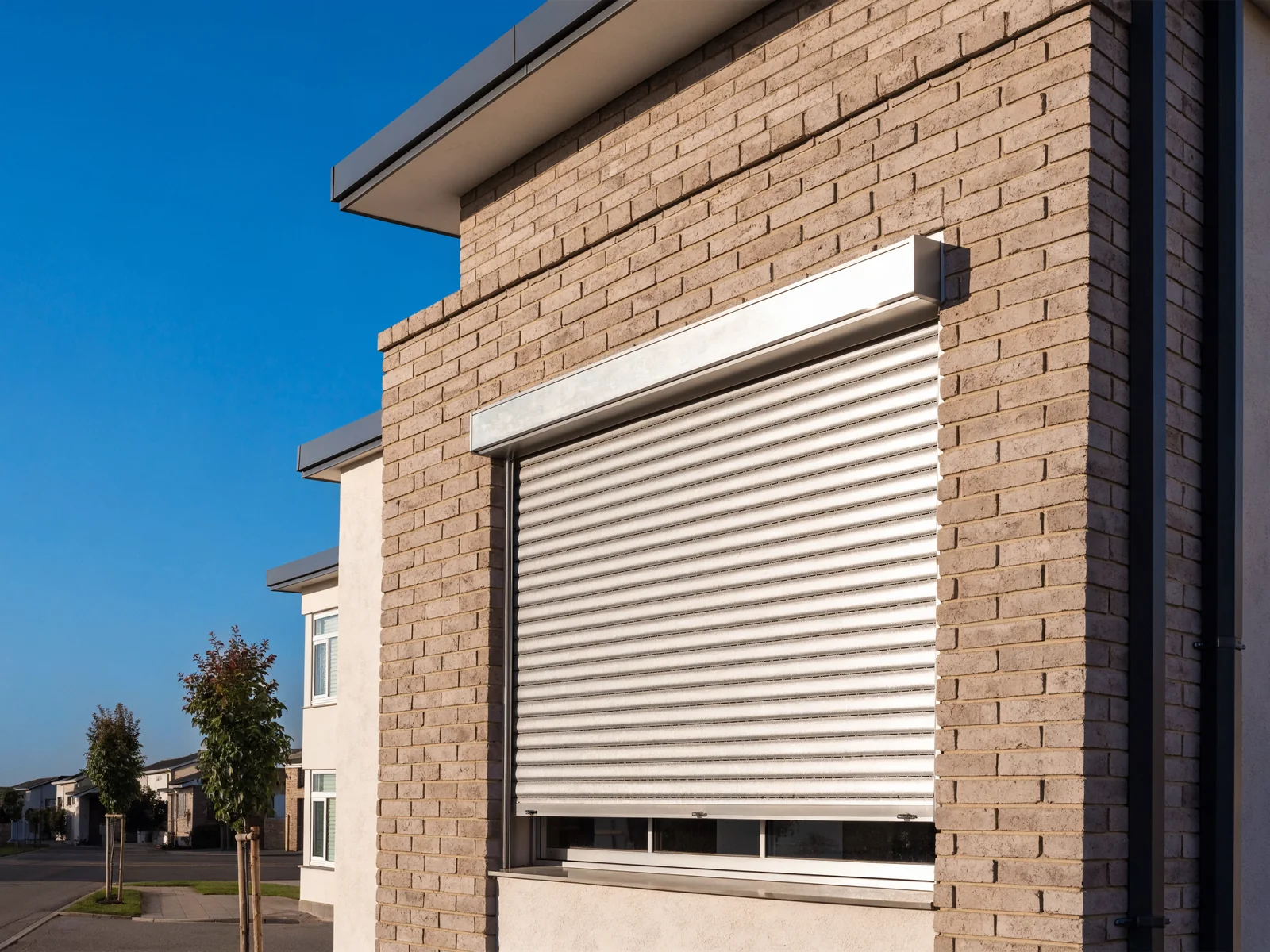
An aluminium roller shutter of rigid horizontal slats rolling down from a slim headbox on the outside of a large ground-floor window of a modern double-storey Midstream estate home, under a wide open Highveld sky with young ornamental street trees in front
Stopped outside the glass. A roller shutter's rigid slats roll down outside the pane — heat and glare turned away before they reach the room. Shading, not security: a different product from a security-rated shutter.

02 — The light here

What the open Highveld sun actually does over Midstream

Midstream sits just south of Pretoria at roughly 25.9° south. The most-cited South African study of sun, shade and daylight for town planning is calculated for Pretoria at 25.733°[3] — about a sixth of a degree away, so its numbers are effectively this estate's sky.

At solar noon on 21 December the sun climbs to about 87.7° — near enough straight overhead. On 20 June it reaches only 40.84°.[3] That 47-degree swing is why one blind rarely answers a whole room across the year: what a summer noon needs and what a winter afternoon needs are almost opposite jobs.

The sunsets matter even more on an open stand. On 21 December the sun sets at an azimuth of 243.35° — twenty-seven degrees south of due west; on 20 June at 295.76°, twenty-six degrees north of it.[3] The setting sun sweeps a ~52° arc along your western horizon through the year, so a fixed eave built for one of those positions is wrong for the other. In the study's own terms: western afternoons run significantly hotter than mornings, horizontal overhangs suit the high sun on north glass, and low east/west sun wants vertical or exterior control instead.[3]

December and June sun paths over an open Midstream stand A wide flat estate horizon with young street trees. The December path arcs almost overhead and sets twenty-seven degrees south of west; the June path stays low and sets twenty-six degrees north of west. 21 Dec · 87.7° at noon 20 Jun · 40.84° at noon East North (midday) West A 52° spread of sunsets, December to June

Sun altitudes and sunset bearings from the published Pretoria figures at 25.733° S[3] — Midstream is a fraction of a degree away.

Three more facts that change what we'd specify

  • High ground, harder UV. Centurion sits at roughly 1,453 m above sea level.[4] UV rises about 12% per 1,000 m because thinner air filters less of it,[5] so west-facing fabric ages faster here than at the coast. On the sun side, choose fabric on performance first and colour second.
  • Storms come in the afternoon, and this is the hail belt. Almost all of Centurion's ~660–735 mm of rain falls in summer,[4] and the Highveld carries roughly 180 hail events across 58 days a year, a Gauteng season peaking in the first half of November with the peak hour between 16:00 and 17:00.[6] That is exactly the hour an awning is out.
  • Winter nights are cold, and low ground is colder. Highveld winters are dry and clear; on a still night cold air drains downhill and pools in low-lying ground,[7] so a stand near a park detention area, a dip or the spruit can feel a frost that higher ground a few metres up escapes.

03 — Room by room

Elevation by elevation, and which rooms suffer

One house, four different problems. Before fabric, before motors, work out which wall the room sits on — on an open Midstream stand it decides more than anything else.

North — protect it in summer, keep it in winter

Where the sun lives all winter: high enough in December that a decent eave does much of the work, then low at 40° and pouring straight in by June.[3] On a cold Highveld morning that winter sun is worth money, so a plain blockout roller is a blunt instrument here — down all day and you've thrown away the warmth you were entitled to.

Verdict: adjustable beats absolute.
West — the elevation that costs you the room

Low, almost horizontal sun from three o'clock, landing anywhere across a 52-degree spread depending on the month[3] — and on most Midstream stands it's also the elevation with the garden or park view you want to keep. If the lounge is unbearable at four, the glass itself is heating and radiating inwards: an interior blind fixes the glare at once and the heat only partly.

Verdict: stop it outside the glass if you can; a proper sunscreen if you can't.
East — first light, over an open garden

The same geometry mirrored, into a house that has cooled all night. In summer the sun clears a low, open estate horizon early and nothing stands between it and the bedroom window — and often two rooms on one wall want opposite things: properly dark where you sleep, still see-through where you take the morning view.

Verdict: solve for sleep and glare, not for heat.
South — even light, and the cold corner

Almost no direct sun for most of the year, so south rooms hold the steadiest light in the house — and are first to feel a cold, clear winter night, especially on low-lying ground where cold air collects.[7] Shading is rarely the issue here; heat loss through a big pane usually is.

Verdict: think warmth, not sun.
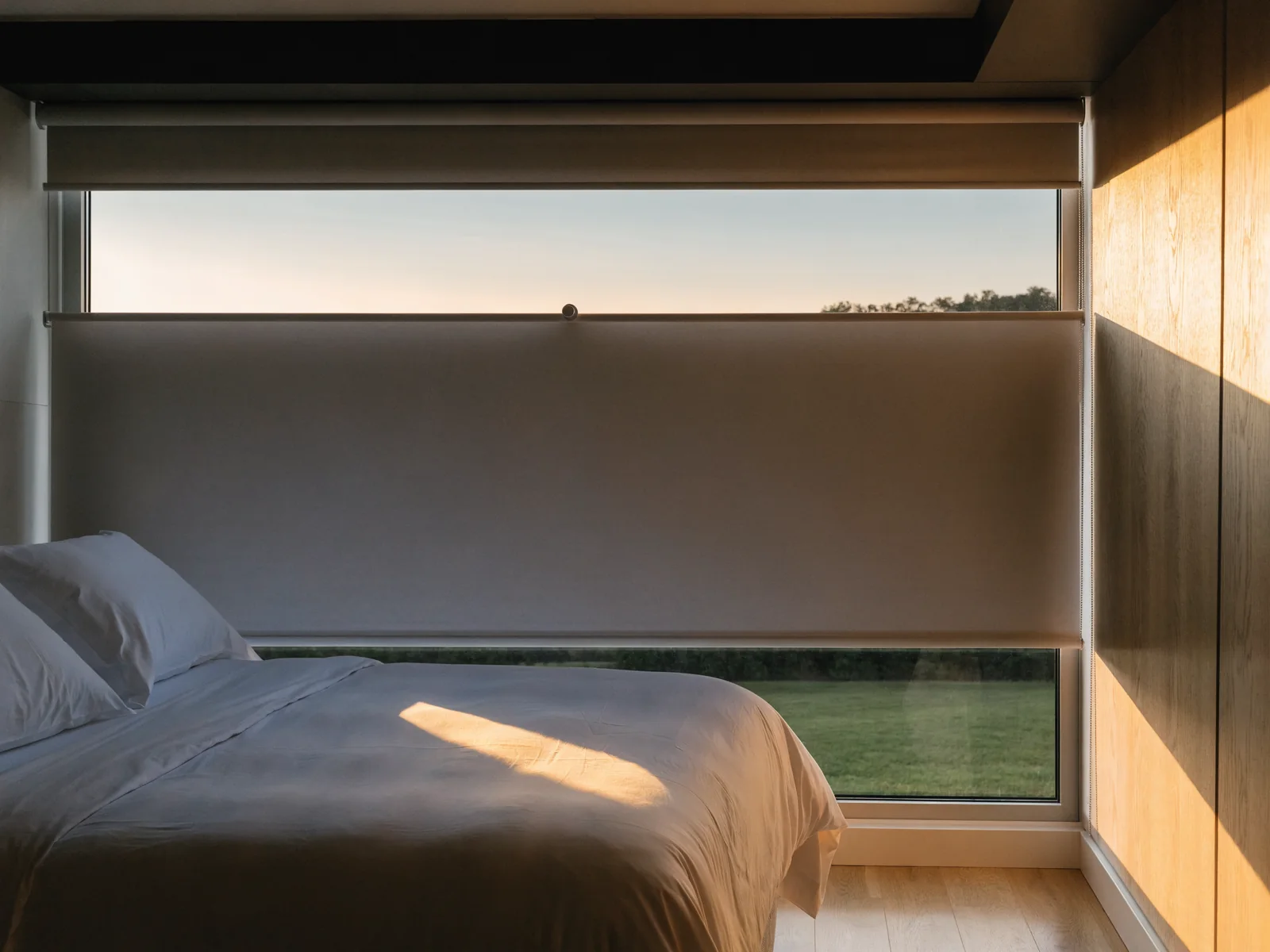
A single smooth flat blockout roller blind, one seamless opaque sheet on a tube with no folds or slats, lowered most of the way over an east-facing Midstream bedroom window at sunrise, with warm low light spilling around the edge and an open landscaped estate garden beyond
Dark where you sleep. A single smooth blockout sheet, no folds for dust to catch — against a low summer sunrise over an open east-facing garden, nothing else comes as close to real darkness.

Optional

Want this Playbook marked up for your own house?

Tell us which rooms are giving trouble and we'll email you this same Playbook with your elevations noted against it — which windows we'd treat first, and what we'd be weighing up on each.

It's an email, not a visit. Nobody phones you about it.

POPIA: your details are used only to send you this Playbook and, if you ask for it, to arrange your free in-home measure. They are never shared or sold.

04 — The specification

What we'd fit at Midstream, and the catch with each

Each of these is right somewhere in an estate home and wrong somewhere else. The trade-off box is the part a brochure leaves out. Tap "Add to my list" and it carries into the window list and the measure form below — no retyping.

Sunscreen roller blinds

West & north living glass

One flat sheet of open-weave mesh on a slim tube — no folds, no gathers. It cuts glare and a useful share of the solar gain while leaving the garden view visible, which out here is the point of the window. Better than a lined curtain, which solves four o'clock by deleting the view you bought the stand for. On Midstream's big west glass, a lower openness (3–5%) blocks more heat and glare; a higher one keeps more view.

The trade-off

It reverses after dark: lights on inside and you become the visible one. Where a boundary road or a neighbouring stand sits close, pair it with a blockout on the same bracket.

Blockout roller blinds

Bedrooms · east elevations

A single smooth sheet, no folds for Highveld dust to settle into, and a genuine thermal layer on a cold night. Against a low summer sunrise over an open east-facing garden, nothing else comes as close to true darkness — the right call for main bedrooms, nurseries and anyone sleeping in daylight hours.

The trade-off

Binary — down is dark, up is everything — so it's the wrong tool on a north living room where you actually want the June sun. Without side channels, light finds the edge of the reveal; ask for channels where you need real black-out.

Day & night (zebra) blinds

Open-plan living

Alternating sheer and solid bands slide past each other, so one blind tunes the light hour by hour — sheer for the morning view, solid for afternoon glare and evening privacy. It's the usual pick for a Midstream open-plan living room whose light changes right through the day.

The trade-off

It's a middle-ground product: not the total dark of a blockout, and the banding never disappears completely. On a hard west wall it manages glare well but won't stop heat like a proper sunscreen or an exterior system.

Cellular / honeycomb blinds

Double-volume · south · low ground

The fabric cells trap still air against the glass — the best-insulating blind we fit. In a south room, a double-volume void that swings between too hot and too cold, or a stand on low ground where cold air pools on a clear night,[7] it's the cheapest thermal improvement short of replacing the window, and it takes the edge off a frosty morning and a blazing January afternoon alike. Cordless as standard.

The trade-off

The gain sits mostly on the winter side of the ledger — it is not a heat-rejection answer for a hard west wall — and it's a soft pleated product, so it's the wrong choice in a dusty scullery.

Aluminium & timber venetian blinds

North rooms · studies · sculleries

On a north elevation the useful control is angle, not coverage: a venetian throws high December sun up onto the ceiling and opens flat in June, so one product handles both ends of that 47-degree swing a roller can't.[3] Aluminium slats shrug off steam and splashes in a kitchen, scullery or bathroom; warm timber suits a study or a formal room.

The trade-off

Slats collect dust and take longer to clean than a flat roller — aluminium wipes down far more easily than timber. And timber is the wrong pick for a steamy bathroom, where it can warp; that is aluminium's job.

Roller shutters (shading)

Hard west walls · hail-exposed glass

Rigid aluminium slats rolling down from a headbox outside the building, covering the whole opening — heat and glare stopped before the glass, total blackout when closed, and a Highveld hail season covered too. Shading, not security: these are shading shutters, not security-rated shutters, which are a different product, built and certified differently, and quoted on request.

The trade-off

The most visible exterior change on this list, and the headbox has to live somewhere — a design decision, not just a measurement. Closed is closed: full coverage, not adjustable light. And it's an aesthetics-committee item at Midstream.

Folding-arm awnings

The covered patio & braai

Where the outdoors is the extra room — and on a Midstream stand it always is — an awning buys more usable house than anything you could do to a window, then folds away and gives back the low winter sun on the paving. Made to the width of the opening, with no posts in the way.

The trade-off

It lives out in the weather, and Highveld hail peaks between four and five in the afternoon.[6] We'd specify a full cassette and a wind sensor that retracts it whether or not you're home — the responsible spec here, not an optional extra.

Motorised blinds & automation

Double-volume · wide glass · anything exterior

At Midstream this is less about luxury than reach and reaction: a three- or four-panel stacking-door blind is heavy by hand, a double-volume blind gets used exactly never if you need a pole, and any exterior product wants a wind sensor to save itself in a November storm.[6] One app, or a sun sensor, can run a whole living wall at once. Rechargeable battery motors cover retrofits with no wiring.

The trade-off

It needs power at the head of the opening — battery, wired or solar — and on a finished ceiling that cable route is the real constraint. Retrofitting is possible but rarely invisible, which is why we like to be in early on a new build.

Also on the list below, for the openings this estate is full of: a double roller (day/night combo) that puts blockout and sunscreen on one bracket for a bedroom with a view; vertical & panel blinds for wide stacking doors that need to draw fully clear; concealed / recessed blind boxes built into the ceiling of a double-volume window before the plaster goes on; zip screens to close an open patio against wind and dust while keeping the view; and blind repairs & re-cording — new cords, chains and tilt mechanisms, whoever fitted the original blind.

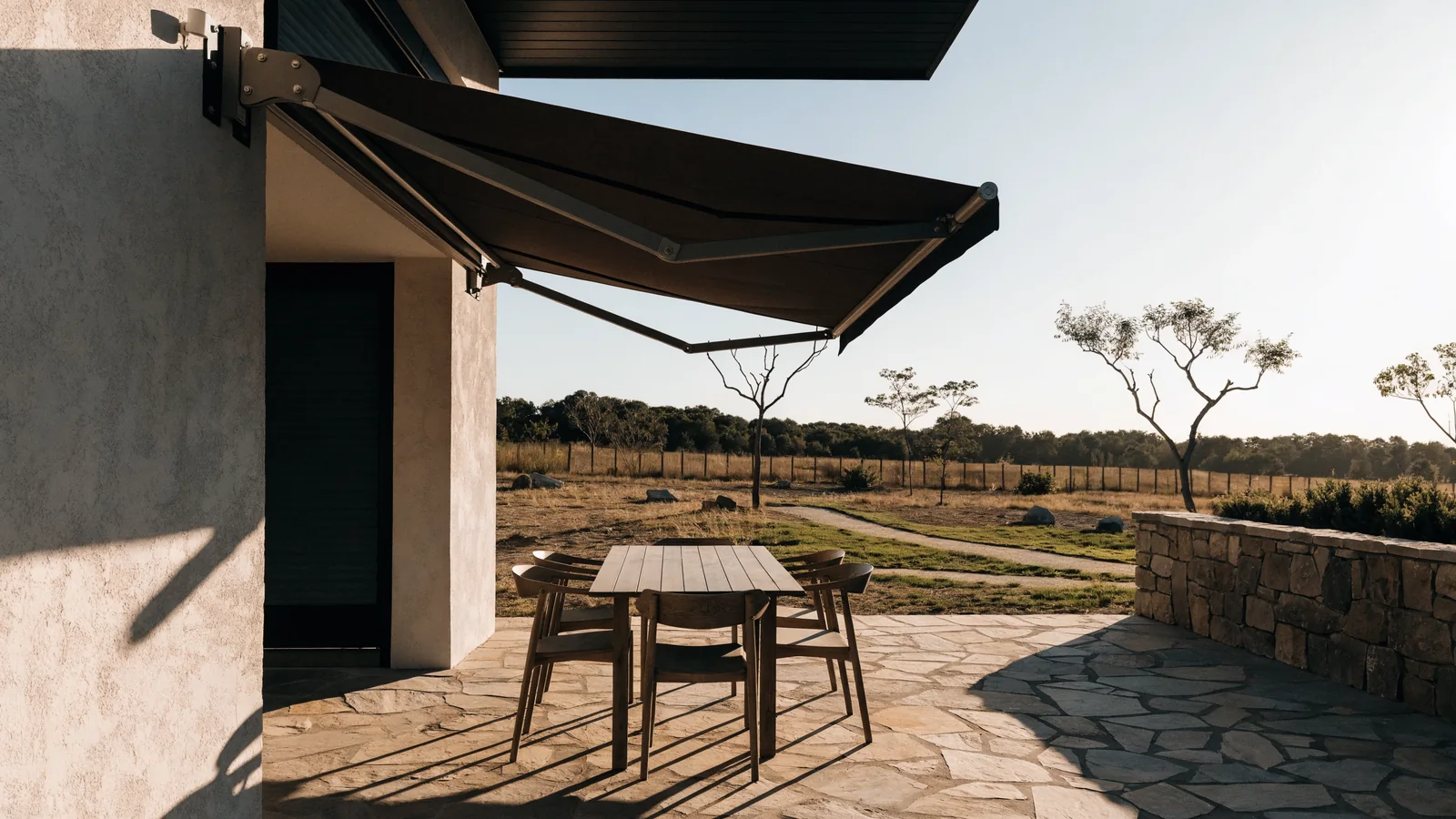
A folding-arm awning fully extended on its articulated arms over a stone-paved covered patio of a modern Midstream estate home, a small wind sensor on the wall bracket, a young landscaped estate park and wide open Highveld sky beyond
The four o'clock question. Projection, fixing height and wind exposure all get decided standing on the paving — and with hail peaking between four and five here,[6] the wind sensor is part of the specification, not an extra.

05 — The local constraint

The estate's own rules, and who has to say yes

Midstream is a managed estate, and that draws a clean line through this whole list. Interior blinds inside an existing reveal change nothing you can see from the road or a neighbouring stand, so the question doesn't arise — a roller, a venetian, a cellular blind is your decision alone. Anything that reads on the outside of the house does raise it: awnings, external screens, roller shutters and zip-screen channels are all visible-from-outside, and an estate aesthetic-approval process has a legitimate say in colour and finish.

That's a reason to plan those items with the committee in mind, not a reason to avoid them. We spec exterior products in powder-coated finishes across a wide colour range and talk facade-matching through with you before anything is ordered, and we can supply the product documentation owners typically submit for sign-off. We fit blinds and won't speak for your HOA — but at the measure we say plainly which options touch the outside, so the right question reaches the right desk before anything is made.

Building or renovating in the estate? Get us in early. A concealed recess has to exist before the ceiling closes, and motor cabling is trivial in an open wall and awkward in a finished one. It's also worth knowing that SANS 10400-XA:2021 raised the fenestration-calculation threshold from 15% to 20% of floor area and no longer draws a distinction between the solar-heat-gain requirements of west-, north- and east-facing glass[8] — so ask your architect how the shading on those big estate windows is being counted.

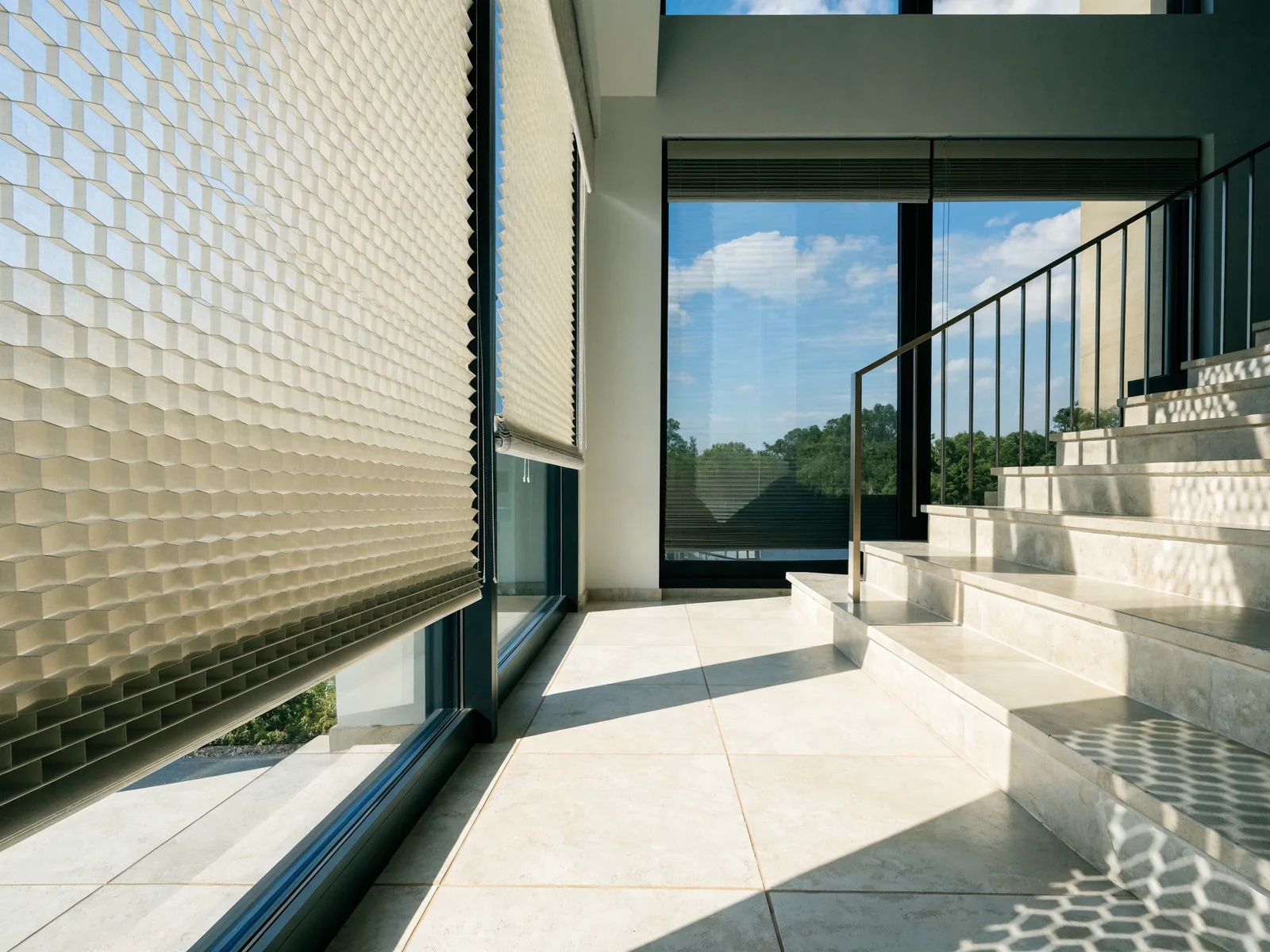
A cellular honeycomb blind, its concertina of hexagonal air cells clearly visible edge-on between two smooth fabric faces, half lowered over the tall glass of a double-volume entrance hall in a modern Midstream estate home, bright Highveld daylight across a pale tiled floor and staircase
The other half of the year. Honeycomb cells holding still air against a double-volume pane. On a frosted Highveld morning it's the cheapest thermal upgrade a big window can be given.

06 — The honest limit of a guide

What we'd still need to check on site

Everything above is what we know about Midstream. What no page can know is your house — and five things decide the actual specification, all settled in about an hour with a tape, a compass and a torch.

The true bearing of each wall

"West-ish" isn't good enough when the sunsets are themselves spread across fifty-two degrees.[3] Twenty degrees of wall rotation moves the answer between an interior sunscreen and something outside the glass, so we take a compass reading at every elevation.

Reveal depth, square-ness, and the wall behind it

Depth decides whether a blind can sit inside the opening at all, and how much light creeps round the edge. Openings are rarely perfectly square — and plastered brick, a drywall bulkhead and an aluminium glazing bar are three different fixings.

Wind exposure across an open stand

This is the Midstream one. With no mature trees or neighbouring building to break it, a patio on the open side of the house sees wind a walled, leafy suburban yard never does. Awnings and zip screens live or die on it — obvious in two minutes on the paving, impossible to judge from a plan.

Where the power is, and how it reaches the opening

For anything motorised the whole constraint is the route from a power point to the head of the window. On double-volume voids and long living walls, that walk-around is the difference between a clean install and a compromise.

What's actually outside the glass

How close the internal road, the park or a neighbour's window sits changes the fabric we'd choose — as does the young tree doing a little of your shading now, and how much more it will do once it's grown.

07 — Two ways forward

Book the free expert measure

A consultant comes to you inside the estate with fabric and slat samples, measures every window properly, and leaves a written quote itemised per window. It costs nothing and commits you to nothing. If you'd rather have a rough number first, the window list sits inside the same form — no obligation either way.

Free in-home measure and a written quote, itemised per window
A real consultant comes to you inside the estate — no showroom trek
Nothing is made until you've approved the quote
Still deciding? Say so on the form and we'll leave you in peace

Our consultant does five or six measures a week across Midstream and the estates around it, so the diary fills early — worth booking ahead if you need a particular day.

Anything you added to your list while reading is already ticked below.

What are you interested in? (tick any)
Want a ballpark first? Open the window list — about two minutes.

Midstream Blinds — window list

Walk the house, fill this in by hand, then type it into the form on midstreamblinds.co.za when you get back. Measure the width first, then the drop, in millimetres.

Pop in rough sizes and we'll send a budget range by the next working day. Not sure how to measure? Leave it blank — our consultant measures for free and you get exact per-window pricing either way. This is entirely optional and nothing here is binding.

Room Width (mm) Drop (mm) Inside or outside the reveal Product Remove

Nothing on the list yet — and it stays entirely optional.

Anything you enter here travels with your enquiry as plain text. No uploads, no third-party services, nothing stored anywhere else. If photographs would help, a consultant will simply ask for them in the reply.

POPIA: your details are used only to arrange your free in-home measure and consultation call-back, and are never shared or sold. If you tell us you're still researching, we won't call you.

Neither, for now

Just take the Playbook, marked up

Not ready for a visit or a number? Tell us which rooms are the problem and we'll email you this Playbook with your own elevations noted against it. Nothing is booked and nobody phones.

POPIA: used only to send you this Playbook. Never shared or sold.

Working out

Sources

Every geography, climate and regulation claim above traces to one of these. Where we've reasoned from them rather than quoted, we've said so in the text.

  1. Midstream — the official estate site, listing the residential precincts (Midstream, Midstream Heights, Midfield, Midlands, Midstream Ridge, Midstream Hill, Midstream Meadows) and the Retire@Midstream village, and marketing the estate's "abundance of open green spaces and well-kept parks". midstream.co.za
  2. Midstream Estate area profile — the core estate described as roughly 1,400 stands (about 800–3,000 m²), established around 2001, across freestanding houses, cluster homes, townhouses and apartments. century21.co.za — Midstream Estate
  3. Conradie, D. (2018) "Sun, shade and natural daylight in South African town planning, with emphasis on Pretoria", Town and Regional Planning 73:47–67 — latitude 25.733°, noon solar elevation 87.7° on 21 December and 40.84° on 20 June, sunset azimuths of 243.35° and 295.76°, the finding that western-exposure afternoons run significantly hotter than mornings, and the guidance that horizontal overhangs suit high-altitude sun on northern facades while low east/west sun wants vertical control. scielo.org.za — S2415-04952018000200005
  4. Centurion, Gauteng — elevation roughly 1,453 m above sea level, subtropical highland (Köppen Cwb) climate, annual rainfall of about 660–735 mm falling almost entirely in the October–March summer, with warm afternoons and cold, clear winter nights. weatherandclimate.com — Centurion
  5. Hong Kong Observatory — ultraviolet radiation at high altitude: "For every 1000 m increase in altitude, the UV radiation level will increase about 12%." hko.gov.hk — UV radiation at high altitude
  6. Punge et al. (2023) "Characteristics of hail hazard in South Africa based on satellite detection of convective storms", Natural Hazards and Earth System Sciences 23:1549–1576 — roughly 180 hail events on 58 days a year in the Highveld, a convective season peaking in the first half of November over Gauteng, and a peak time of day between 16:00 and 17:00 South African standard time. nhess.copernicus.org/articles/23/1549/2023
  7. FAO, Frost protection: fundamentals, practice and economics — cold air is denser than warm air, drains downhill on clear, calm nights and pools in low-lying ground, so a hollow can carry frost while higher ground nearby does not. fao.org — frost protection (PDF)
  8. Roos Architects — summary of the revised SANS 10400-XA standard (2021 edition): the fenestration threshold rising from 15% to 20% of floor area, and no distinction now drawn between the solar-heat-gain requirements of glazing facing west, north or east. roosarchitects.co.za — revised SANS 10400-XA

Two honest caveats. The solar figures in source 3 are calculated for Pretoria at 25.733° south; Midstream sits a fraction of a degree further south, so its own angles differ slightly — we quote the published numbers rather than invent our own. And the hail and frost material is regional and physical, not a Midstream measurement: there is no published hail or frost record for this estate specifically, which is one more reason we look at your particular stand in person rather than at a map.

Ready when you are

Now let's look at your actual windows.

One visit, real measurements, a written quote per window — and no obligation to go ahead.